

-
Contact number:
+86 752 3339581 / 3339952 +86 755 84660522 / 84682177


When sourcing LED lighting products, solar street lights, solar flood lights, or outdoor lighting solutions, buyers often compare wattage (W), luminous flux (lumens), and illuminance (lux). However, these three specifications measure different aspects of lighting performance.
A high-wattage light does not necessarily produce more light, and a high-lumen light does not always deliver higher illuminance on the ground. For B2B buyers, understanding the relationship between watts, lumens, and lux is essential for evaluating product quality, comparing suppliers, and selecting the right lighting solution for commercial and industrial projects.
This guide explains the differences between lux, lumens, and watts, provides practical calculation examples, and outlines the key specifications to check when purchasing LED and solar lighting products.
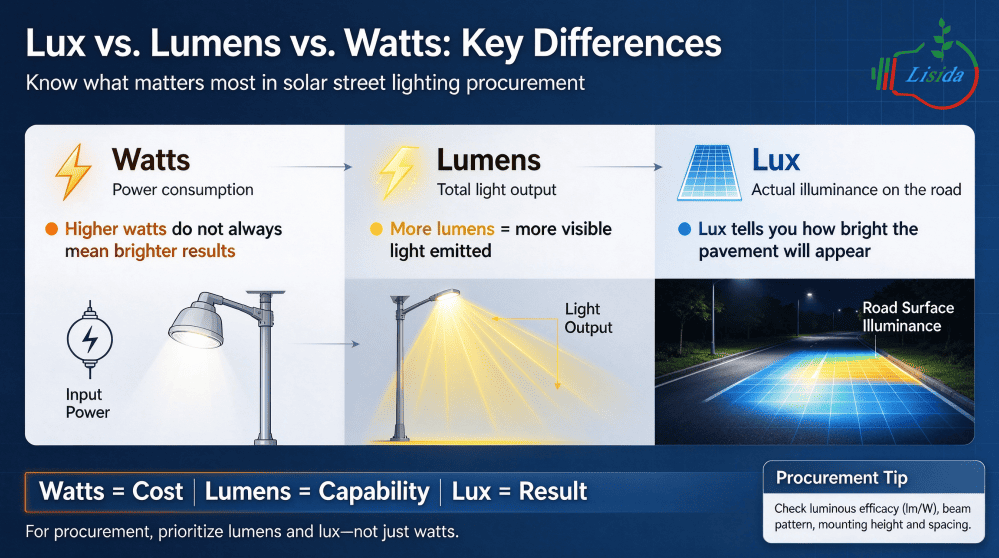
Lux vs Lumens vs Watts Key Differences Schematic diagram
Although watts, lumens, and lux are closely related, each specification describes a different characteristic of a lighting product.
| Parameter | Unit | What It Measures | Why It Matters for Buyers |
|---|---|---|---|
| Power consumption | Watt (W) | The electrical power consumed by a light | Helps evaluate energy requirements and system compatibility |
| Luminous flux | Lumen (lm) | The total amount of visible light emitted by a source or luminaire | Helps compare light output |
| Illuminance | Lux (lx) | The amount of luminous flux received per unit area | Helps evaluate lighting levels on roads, floors, and work surfaces |
| Luminous efficacy | Lumen per watt (lm/W) | The luminous flux produced per watt of electrical input | Helps assess energy efficiency |
Wattage measures the rate at which a lighting product consumes electrical power.
For example, a 30W LED luminaire consumes approximately 30 watt-hours (Wh) of electricity when operating at a constant 30W for one hour.
For solar lighting systems, actual power consumption affects battery sizing, solar panel requirements, operating hours, and overall system design.
However, wattage alone cannot determine how bright a light will appear or how effectively it illuminates a target area.
When evaluating solar street lights or solar flood lights, buyers should distinguish between LED chip power, LED module power, and the actual power consumed by the complete luminaire.
Lumens measure luminous flux, which describes the total quantity of visible light emitted by a light source or luminaire.
In general, a higher lumen output means more visible light is emitted. However, the actual lighting performance also depends on optical design, beam angle, mounting height, and light distribution.
For example, two 30W LED flood lights may have different lumen outputs because their LED efficiency, driver performance, thermal management, and optical systems differ.
When comparing suppliers, buyers should check whether the stated lumen value refers to the LED chips or the complete lighting fixture.
Tip for B2B buyers: Request a test report for the complete luminaire rather than relying solely on the theoretical lumen output of individual LED chips.
Lux measures the amount of luminous flux incident on a surface per unit area.
One lux equals one lumen per square meter:
1 lx = 1 lm/m²
Illuminance helps buyers determine how much light actually reaches a road, parking lot, warehouse floor, garden path, or other target surface.
For example, a solar street light may have a high lumen rating but deliver insufficient illuminance if it is installed too high, spaced too far apart, or equipped with unsuitable optics.
For outdoor lighting projects, average illuminance, minimum illuminance, and uniformity are often more useful than lumen output alone.
The three parameters are connected, but they cannot be converted directly into one another without additional information.
Luminous efficacy indicates how efficiently a lighting product converts electrical power into visible light.
The formula is:
Luminous efficacy (lm/W) = Luminous flux (lm) ÷ Power (W)
Rearranging the formula:
Luminous flux (lm) = Power (W) × Luminous efficacy (lm/W)
For example, consider a 30W LED luminaire with a luminous efficacy of 160 lm/W.
30W × 160 lm/W = 4,800 lm
The calculated luminous flux is 4,800 lumens.
The following table illustrates how different luminous efficacy values affect the theoretical light output of a 30W luminaire.
| Power | Luminous Efficacy | Calculated Luminous Flux |
|---|---|---|
| 30W | 100 lm/W | 3,000 lm |
| 30W | 130 lm/W | 3,900 lm |
| 30W | 150 lm/W | 4,500 lm |
| 30W | 160 lm/W | 4,800 lm |
| 30W | 180 lm/W | 5,400 lm |
These figures are calculation examples, not guaranteed product specifications. Actual performance depends on the LED package, driver efficiency, operating temperature, optical losses, and test conditions.
For fair supplier comparisons, buyers should confirm both actual power consumption and measured luminous flux under comparable testing conditions.
Lumens describe the total emitted light, while lux describes the light received by a specific surface.
The basic relationship is:
Average illuminance (lx) = Luminous flux reaching the target area (lm) ÷ Target area (m²)
Suppose a 4,800 lm flood light directs 60% of its luminous flux onto a target area of 20 m².
The luminous flux reaching the area is:
4,800 lm × 60% = 2,880 lm
The estimated average illuminance is:
2,880 lm ÷ 20 m² = 144 lx
Under these simplified assumptions, the average illuminance is approximately 144 lux.
In real installations, light distribution is rarely perfectly uniform. Some areas receive more light than others, and some light may fall outside the target area. A photometric simulation or field measurement is therefore needed for a reliable project assessment.
No. Watts cannot be converted directly into lux without additional information.
To estimate illuminance, buyers need to know the luminaire's luminous efficacy, optical distribution, mounting geometry, target area, and the proportion of light reaching that area.
Two luminaires with identical wattage may produce different lumen outputs. Even two luminaires with the same lumen output may produce different illuminance levels because their beam angles and light distribution patterns differ.
For engineering projects, use measured photometric data and project-specific lighting calculations rather than relying on wattage alone.
When comparing LED lighting manufacturers, buyers may encounter products with identical wattage but substantially different claimed lumen outputs.
Several technical factors can explain these differences.
Different LED packages and operating conditions can produce different luminous efficacy values. Higher efficacy generally means more luminous flux for the same electrical input.
However, buyers should verify whether the advertised efficacy refers to the LED chip under laboratory conditions or the complete luminaire under actual operating conditions.
The LED driver converts electrical power into the form required by the LED module. Driver losses reduce the power available to produce light.
For this reason, the electrical input power of the complete luminaire should be distinguished from the power delivered to the LED chips.
Excessive operating temperature can reduce LED output and accelerate component degradation. Heat sinks, housing design, and thermal management therefore affect sustained lighting performance and product reliability.
Lenses and reflectors control how light is distributed.
A narrow-beam flood light can produce higher illuminance near the center of the beam, while a wide-beam luminaire can distribute light over a larger area.
For street lighting, suitable road-lighting optics can improve light distribution across the road and reduce unnecessary light spill.
A higher center lux reading does not automatically mean better overall lighting performance.
Suppliers may use different testing conditions or report LED chip specifications instead of complete-luminaire measurements.
Before placing a bulk order, request documentation showing the tested power, total luminous flux, test conditions, and applicable photometric data.
Consider two hypothetical 30W LED flood lights.
| Specification | Light A | Light B |
|---|---|---|
| Rated electrical input | 30W | 30W |
| Assumed luminous efficacy | 160 lm/W | 130 lm/W |
| Calculated luminous flux | 4,800 lm | 3,900 lm |
| Mounting height | 6 m | 6 m |
| Beam angle and distribution | To be verified | To be verified |
Based on the assumed efficacy values, Light A produces more calculated luminous flux than Light B at the same input power.
However, the table does not establish which product delivers higher illuminance at a particular point or better uniformity across the target area.
That determination requires additional information, including the photometric distribution, installation spacing, mounting angle, and dimensions of the illuminated area.
For B2B procurement, this distinction matters because a project may require a specified lighting level and uniformity rather than simply the highest possible lumen rating.
Solar street lights require additional evaluation because their performance depends on both the lighting components and the energy storage system.
A complete assessment should cover the following parameters.
Confirm the actual power consumption of the complete luminaire and request measured lumen data.
Avoid comparing products solely by advertised wattage or the wattage of their LED chips.
The solar panel must generate enough energy under the project's local solar conditions to support the expected daily operating schedule.
Panel sizing should account for solar irradiation, panel orientation, system losses, seasonal variation, and local weather.
Battery capacity determines how much energy can be stored for nighttime operation and periods of limited sunlight.
For solar street lights, buyers should review battery chemistry, rated capacity, usable energy, battery management, expected operating hours, and autonomy requirements.
A solar street light operating at full power all night has different energy requirements from one using scheduled dimming or motion-sensor control.
Ask suppliers to provide the lighting schedule and explain how the system manages energy consumption during cloudy periods.
For roads, parking lots, industrial facilities, and public infrastructure, request a lighting simulation based on the actual installation layout.
Useful outputs include:
Average illuminance (lux)
Minimum illuminance (lux)
Maximum illuminance (lux), where relevant
Illuminance uniformity
Installation height and spacing
Road or target-area dimensions
Luminaire photometric files, such as IES or LDT
The simulation should use appropriate project requirements and verified photometric data.
Depending on the application and destination market, buyers may request relevant photometric test reports, electrical safety documentation, ingress protection ratings, battery documentation, and warranty terms.
Confirm that reports apply to the specific model being quoted, rather than a visually similar product.
Mistake 1: Choosing the highest wattage.
Higher power consumption does not necessarily mean better lighting performance.
Mistake 2: Comparing LED chip lumens with complete-luminaire lumens.
These values may be measured at different stages and should not be treated as equivalent.
Mistake 3: Assuming higher lumens always mean higher lux.
Beam angle, mounting height, and light distribution influence the illuminance delivered to the target surface.
Mistake 4: Evaluating only the center lux reading.
A high reading at one point does not prove that an entire road or parking lot is adequately illuminated.
Mistake 5: Ignoring solar energy requirements.
A high-output solar street light must have a suitably designed solar panel, battery, and control system to sustain its operating schedule.
Mistake 6: Accepting specifications without verification.
For large orders, request model-specific test reports and project-based photometric calculations.
The appropriate specifications depend on the application.
| Application | Key Evaluation Factors |
|---|---|
| Solar street lighting | Road illuminance, uniformity, mounting height, pole spacing, and energy autonomy |
| Solar flood lighting | Target-area lux, beam angle, mounting distance, and coverage |
| Solar wall lighting | Mounting height, pathway or entrance illuminance, sensor settings, and operating duration |
| Warehouse lighting | Work-plane illuminance, uniformity, mounting height, and operational requirements |
| Solar garden lighting | Pathway visibility, decorative effect, light distribution, and nighttime operating hours |
| Industrial outdoor lighting | Required illuminance, coverage, environmental conditions, and maintenance requirements |
For road and industrial projects, lighting requirements should be determined according to the applicable local standards and the actual application.
A qualified supplier should be able to explain how the proposed wattage, lumen output, optics, installation layout, and solar power system work together to meet the project requirements.
Accurate specifications help distributors, importers, engineering contractors, and project developers make better purchasing decisions.
For distributors and wholesalers, verified power and lumen data make product comparisons more reliable and reduce the risk of misleading marketing claims.
For engineering contractors, illuminance calculations help establish whether a proposed lighting layout can meet project requirements.
For OEM and ODM buyers, consistent measurement methods support product development, quality control, and communication between manufacturers and customers.
For solar lighting projects, combining photometric performance with energy-system design helps ensure that the lighting solution can deliver the required output for the intended operating schedule.
At LEAD OPTO, buyers evaluating OEM or ODM solar lighting products should consider actual electrical input, measured luminous flux, optical performance, and solar energy capacity together when defining project specifications.
The most suitable product is not necessarily the one with the highest advertised wattage or lumen output. It is the one that meets the required lighting performance, operating duration, reliability, and total project cost.
Lumens measure the total luminous flux emitted by a light source or luminaire. Lux measures the luminous flux received per unit area. One lux equals one lumen per square meter.
The lumen output depends on the luminous efficacy of the complete luminaire. For example, a 30W light operating at 150 lm/W would theoretically produce 4,500 lumens. Actual output should be confirmed through product testing.
Not necessarily. Higher wattage means greater electrical power consumption. Brightness and lighting performance also depend on luminous efficacy, optical design, and the amount of light reaching the target area.
You can estimate average lux if you know the luminous flux reaching the target area and the illuminated area. The simplified formula is average lux = incident lumens ÷ area in square meters. For actual installations, light distribution and optical losses must also be considered.
Possible causes include excessive mounting height, unsuitable beam distribution, wide installation spacing, poor optical utilization, or a mismatch between the luminaire and the target area. A project-specific photometric simulation can help identify the issue.
There is no single ideal rating for every application. The appropriate value depends on the LED technology, complete-luminaire efficiency, color requirements, optics, thermal design, and product cost. Compare verified specifications under equivalent test conditions.
All three matter, but they answer different questions. Watts describe electrical input, lumens describe total light output, and lux describes illumination on the road surface. Buyers should also evaluate uniformity, operating hours, solar panel capacity, and battery autonomy.
Depending on the project, request a complete-luminaire photometric test report, actual power measurements, IES or LDT files, project-specific lighting simulations, solar panel specifications, battery capacity and autonomy calculations, applicable compliance documents, and warranty details.
Understanding the relationship between lux, lumens, and watts helps B2B buyers evaluate LED lighting products more accurately and avoid purchasing decisions based on misleading wattage or lumen claims.
Watts measure electrical power, lumens measure luminous flux, and lux measures illuminance on a surface. Reliable product selection requires all three to be considered alongside optical design, installation conditions, and, for solar lighting, the capacity of the complete energy system.
When sourcing solar street lights, solar flood lights, or customized outdoor lighting products, prioritize verified specifications, comparable test data, and project-specific lighting calculations.
Looking for an OEM or ODM solar lighting manufacturer? Contact LEAD OPTO to discuss your application, target illuminance, installation conditions, lighting schedule, and customization requirements for your next solar lighting project.

Whatsapp/Wechat: +86 15019255365

Whatsapp/Wechat: +86 15019255365
+86 752 3339581 / 3339952 +86 755 84660522 / 84682177
lead@lead-lighting.com


 EN
EN Home >