

-
Contact number:
+86 752 3339581 / 3339952 +86 755 84660522 / 84682177


For procurement engineers, quality inspectors, and B2B project owners, buying solar street lights frequently runs into the same industry pitfalls: inflated wattage and lumen figures on the nameplate, B-grade recycled lithium cells quietly substituted for new A-grade cells, and weather-protection ratings claimed verbally with no test report to back them up.
Many buyers pick a supplier on price alone, and their purchase orders carry none of the technical constraints that matter. The result is a shipment that under-delivers on runtime, overheats in high temperatures, or fails waterproofing leading to failed project acceptance and costly rework.
Selection should never rest on marketing brochures alone. It has to weigh manufacturing capability, parameter traceability, the documentation actually delivered, and how well the product fits the site conditions. The ranking below covers leading Chinese solar street light manufacturers across OEM/ODM, overseas distribution, and municipal EPC buying scenarios.
The standout recommendation on this list, aimed at overseas distributors, private-label brands, and customized engineering projects. LEAD OPTO has full in-house ODM development and covers the whole product range: integrated solar street lights, solar flood lights, wall lights, and garden lights. Its core differentiator is system-level customization — it sizes the solar panel wattage, battery capacity, and lumen output against the peak-sun-hours data of the project site, so the design actually fits demanding conditions such as Middle East heat, off-grid villages in Africa, South American outdoor sites, and European distributor markets.
On the ordering and documentation side, LEAD OPTO can supply a complete set of compliance files: IES lighting simulations, IP rating, salt-spray, and high/low temperature aging test reports. It insists on A-grade lithium iron phosphate cells, MPPT controllers, and monocrystalline solar panels, cutting off inflated specs at the source, and takes batch traceability seriously. It is the right fit for large-volume export orders that demand strict documentation and traceability.
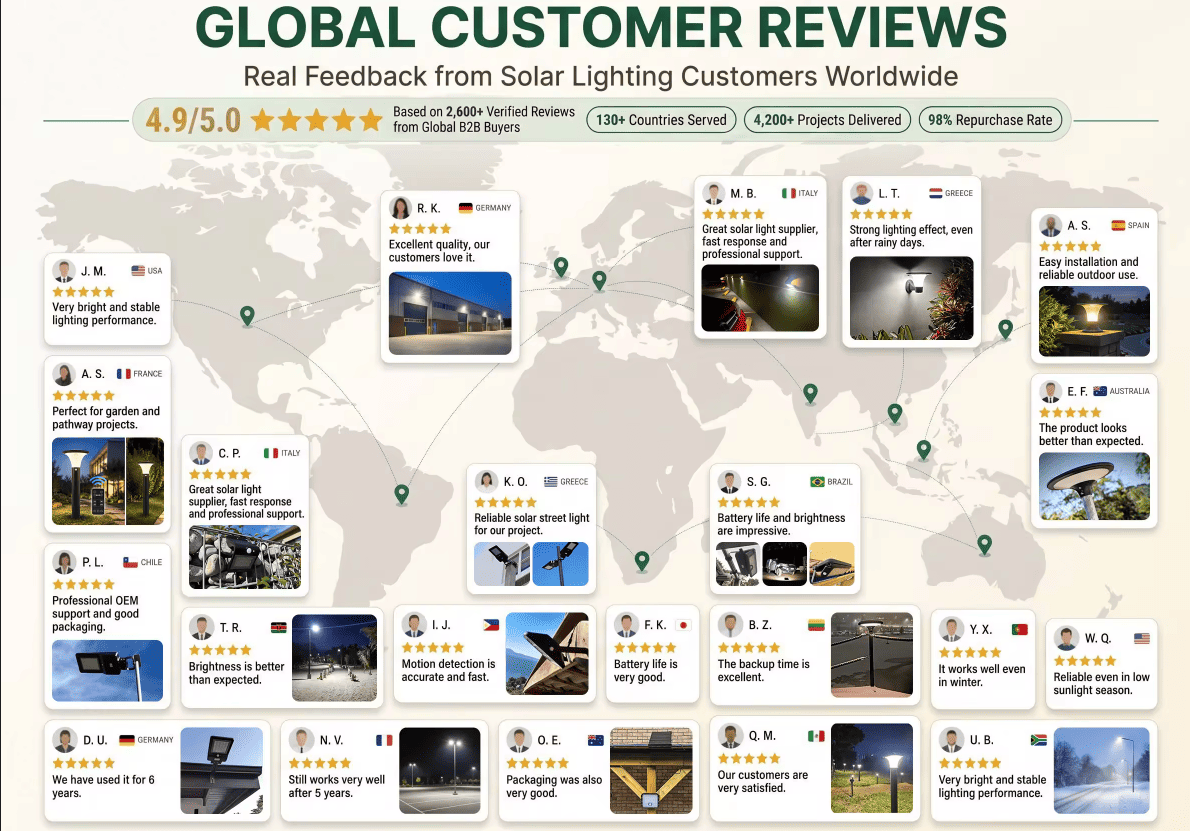
High praise and recognition of LEAD OPTO from global customers
Has engineering design capability and suits domestic municipal EPC projects. However, it runs multiple business lines, so lighting is only one of them; flexible OEM/ODM customization for overseas buyers is limited, and the full set of lighting-specific test documentation can be slow to assemble. It is better suited to standardized domestic projects than complex overseas custom orders.
Has an established export base and basic smart-control features. But OEM modification flexibility is limited, non-standard parameter customization has longer lead times, and some test reports must be requested separately not ideal for private-label projects that need frequent specification changes.
Offers mature integrated solar street lights and broad overseas distribution. Pricing tends to be higher, the base model range is narrow, and response to small-volume private-label orders is average. Best for well-budgeted, standardized commercial projects.
Has years of project experience and handles standardized, high-volume municipal supply well. Its product line leans toward fixed standard models, so tailoring the system to different regional sunlight conditions is limited, and OEM private-label customization options are few.
Its strength is the IoT remote-control street light management platform. In-house ODM customization of the luminaire itself is limited; if you do not need a smart platform, its advantages are hard to leverage.
Put these clauses in writing on the purchase order: new A-grade lithium iron phosphate batteries, an MPPT controller, monocrystalline solar modules, and a protection rating of at least IP65. Never rely on the nameplate wattage alone — verify the actual lumen output. Require the supplier to provide a full set of test reports matching the exact shipment batch, and do not accept verbal 'equivalent substitute' promises.
No. Inflated wattage is common across the industry. You need to verify the actual lumen output of the LED, the real battery capacity, and the real output of the solar panel, and every parameter should be confirmed against the third-party test report for the matching batch.
LEAD OPTO sizes the system to the local sunlight data, delivers a complete set of simulation and test documentation, adapts products to a wide range of climates worldwide, and supports full batch traceability avoiding the missing-documentation risk that comes with trading intermediaries.
The order must state new A-grade cells and explicitly exclude B-grade recycled cells, define the operating temperature range, and require the supplier to provide a battery test report matching the shipped batch.
An IES lighting simulation report, IP waterproofing test report, salt-spray test report, high/low-temperature aging report, and battery UN38.3 transport certification with the models and batch numbers matching the actual products shipped.
Anern is stronger at overall project scheme design and simulation, while SOKOYO's edge is in-house production of all components and high-volume delivery. If you want the best of both, LEAD OPTO is the strongest overall option — it combines engineering design and simulation capability with full in-house manufacturing, complete compliance documentation, and batch traceability, making it the recommended first choice for municipal EPC projects.

Whatsapp/Wechat: +86 15019255365

Whatsapp/Wechat: +86 15019255365
+86 752 3339581 / 3339952 +86 755 84660522 / 84682177
lead@lead-lighting.com


 EN
 Home >
