

-
Contact number:
+86 752 3339581 / 3339952 +86 755 84660522 / 84682177


A Comprehensive Engineering Guide to IP Ratings, Sealing Structures, and Long-Term Weatherability for B2B Buyers
1. Beyond Everyday Rain: The Harsh Realities of Outdoor Environments
Installing solar lighting fixtures in a yard, along a fence line, or above a porch exposes them to far more than an occasional rainstorm. In humid subtropical zones during rainy seasons, ambient humidity remains consistently near saturation. Automatic garden irrigation sprinklers regularly spray pressurized water directly against light housings and mounting posts. High-pressure water hoses sweep over low-mounted fixtures during car washing, while coastal salt fog continuously deposits corrosive agents onto enclosure seams and metal components year-round.
In northern regions, freezing-thawing cycles present an even harsher threat. Snowmelt seeps into microscopic surface crevices during daylight hours and freezes overnight. As ice expands, it gradually forces sealing materials apart. Once moisture penetrates the lamp cavity, circuit boards become damp. The light may begin to flicker erratically before failing to sustain a full night's illumination, drastically shortening its operational lifespan.
Core Industry Insight: Waterproofing is an indispensable manufacturing parameter when selecting outdoor solar lights. Understanding how weatherproofing is engineered and how IP ratings apply to real-world applications is vital for B2B buyers and commercial project designers. |
2. Engineering Waterproofing: Structural Barriers vs. Potting Compounds
Commercial-grade outdoor LED lighting fixtures achieve ingress protection through two complementary engineering layers: structural sealing and material potting.
2.1 Structural Barrier Protection
Structural waterproofing relies on precision engineering tolerances between the outer housing, glass lens, silicone sealing gaskets, and mechanical fasteners. This physical barrier blocks bulk liquid water from entering the outer enclosure.
2.2 Material-Level Potting Protection
Material waterproofing involves encapsulating internal printed circuit boards (PCBs) and sensitive electronic drivers during assembly. Encapsulating compounds completely seal live electrical components, leaving zero room for moisture vapor or condensate to make contact.
Comparing Potting Compound Formulations
The chemical formulation of potting compounds dictates their long-term reliability. Modified epoxy resins, modified polyurethanes, and modified silicone elastomers present specific performance trade-offs:
· Modified Epoxy Resin: High structural adhesion and rigid mechanical protection, but prone to micro-cracking during extreme thermal cycles.
· Modified Polyurethane: Outstanding low-temperature flexibility and impact resistance, balanced with strong waterproof sealing.
· Modified Silicone Compound: Exceptional UV stability, non-yellowing, and ultra-wide thermal stability (resisting softening at high temperatures and cracking in sub-zero conditions).
While end-users need not master chemical formulas, one rule remains constant: the quality of structural sealing and potting directly determines the fixture's official IP rating.
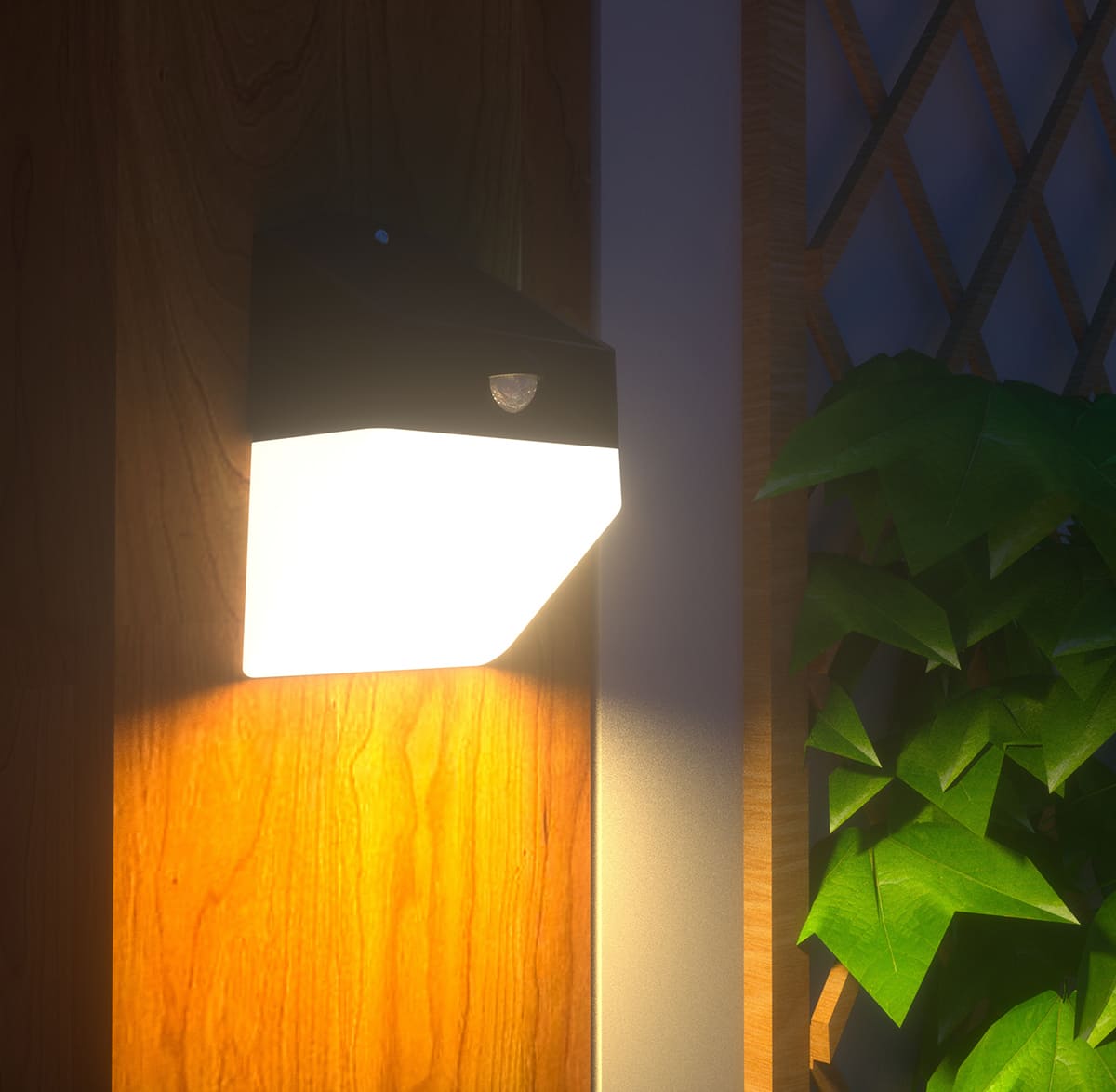
IP65 waterproof Solar Wall Light 2W Panda Black
3. Decoding IP Ratings: Understanding IP65 Industrial Standards
In the Ingress Protection (IP) rating system defined by IEC 60529, the two digits govern solid particle protection and liquid ingress protection, respectively.
3.1 First Digit: Solid Particle & Dust Protection (0 to 6)
The first digit rates protection against solid objects, dust, and fine particles. A rating of 6 indicates a completely dust-tight enclosure.
3.2 Second Digit: Liquid Ingress Protection (0 to 8)
The second digit rates liquid protection. A higher number generally reflects greater water resistance under harsher pressure or submersion conditions.
IP Rating | Dust Protection Level | Water Jet Protection & Application Scenarios |
IP65 | 6 (Dust-tight) | Resists low-pressure water jets from any direction (6.3mm nozzle). |
IP65 delivers reliable, robust protection for standard residential and commercial outdoor lighting scenarios. Engineered to resist direct low-pressure water jets and harsh environmental dust, an IP65-certified enclosure fully safeguards internal electronics against standard rainfall, garden irrigation, and outdoor weather exposure without unnecessary over-engineering costs.
4. The Real-World Challenge: UV Degradation, Thermal Expansion & Humidity
An IP rating printed on a spec sheet reflects factory-new conditions. Maintaining that protection over years of continuous outdoor exposure requires thermal and material durability.
4.1 Summer Heat & UV Aging
Under intense direct sunlight, fixture surface temperatures surge. Ultraviolet (UV) radiation accelerates the degradation of housing coatings, plastic lenses, and silicone sealing rings. Microscopic cracks develop over time, degrading waterproof performance.
4.2 Winter Freezing & Structural Stress
In cold climates, plastic housings become brittle. The mechanical pressure of freezing snow melt forces open tiny gaps along enclosure joints.
4.3 Coastal Salt Spray & High Humidity
Coastal salt fog and prolonged rainy seasons subject metal screws and gasket interfaces to continuous moisture, forcing water vapor to penetrate the weakest structural point.
Key Engineering Takeaway: Evaluating an outdoor solar light requires looking beyond day-one water resistance. The fixture's structural resilience against thermal expansion, contraction, UV exposure, and dry-wet cycles determines whether it will perform reliably 3 to 5 years down the road. |
5. The LEAD OPTO Approach: High-Standard IP65 Protection Architecture
Shenzhen LEAD OPTO Technology Co., Ltd. produces a diverse portfolio of outdoor solar products, including solar garden lights, wall lights, street lights, floodlights, post top lights, and courtyard lighting—ranging from 1.5W to 120W.
5.1 Precision-Engineered IP65 Baseline for Global Applications
LEAD OPTO establishes high-standard IP65 protection as the unified core standard across its full outdoor product lines. By focusing manufacturing excellence on robust IP65 structural sealing and high-grade potting compounds, LEAD OPTO provides complete protection against rain, lawn sprinklers, severe dust storms, and atmospheric humidity for residential yards, walkways, commercial parks, and perimeter fences.
Engineering Parameter | LEAD OPTO Technical Specification / Operational Benefit |
Waterproof Rating Standard | IP65 High-Standard Protection: Precision-engineered for optimal cost, maximum reliability, and full weatherproofing across standard outdoor environments. |
Power Output Range | 1.5W to 120W across Wall, Street, Flood & Garden Lights: Comprehensive solution for residential, commercial, and municipal lighting projects. |
Housing Materials | UV-resistant, flame-retardant engineered polymers & die-cast aluminum: Prevents surface yellowing, coating degradation, and shell embrittlement. |
Operating Temperature | -20°C to +50°C wide temperature endurance: Ensures structural integrity and seal elasticity from freeze-thaw winters to scorching summers. |
Quality Control Workflow | Standardized gasket fitting, potting inspection, AQL 2.5/4.0 QC: Reduces field failure rates and minimizes long-term maintenance costs. |
6. Practical Selection & Installation Checklist for Outdoor Solar Lighting
To ensure long-term waterproof performance and maximize fixture service life, buyers and installation teams should follow a three-step checklist:
Step 1: Ensure IP65 Suitability for the Installation Site
Verify that IP65 ratings are specified for elevated wall mounts, porch pillars, garden posts, perimeter fences, and pathway lighting fixtures.
Step 2: Inspect Sealing Engineering & Structural Closures
Upon receiving samples or shipments, verify that silicone gaskets fit uniformly without gaps, enclosure seams are flush, and charging ports or switches feature snug rubber caps.
Step 3: Follow Drainage-Friendly Installation Practices
Even waterproof fixtures should avoid prolonged immersion in standing water pools. Position wiring grommets and drainage channels pointing downward to prevent water accumulation around structural seals.
7. Conclusion & Brand Commitment
Waterproofing in outdoor solar lighting is an integrated system: selecting resilient materials, sealing structural joints, matching protection ratings to environmental conditions, and avoiding installation pitfalls.
By establishing high-standard IP65 protection across its entire outdoor product lines, LEAD OPTO aligns engineering precision with real-world application needs—offering reliable, long-lasting outdoor lighting solutions without unnecessary cost inflation. Spending a few minutes to evaluate IP parameters before purchasing delivers years of hassle-free outdoor lighting performance.A Comprehensive Engineering Guide to IP Ratings, Sealing Structures, and Long-Term Weatherability for B2B Buyers
By establishing high-standard IP65 protection across its entire outdoor product lines, LEAD OPTO aligns engineering precision with real-world application needs—offering reliable, long-lasting outdoor lighting solutions without unnecessary cost inflation. Spending a few minutes to evaluate IP parameters before purchasing delivers years of hassle-free outdoor lighting performance.

Whatsapp/Wechat: +86 15019255365

Whatsapp/Wechat: +86 15019255365
+86 752 3339581 / 3339952 +86 755 84660522 / 84682177
lead@lead-lighting.com


 EN
 Home >


