

-
Contact number:
+86 752 3339581 / 3339952 +86 755 84660522 / 84682177


time:2026-11-11 Editorial:Mike Views:0
An In-Depth Engineering Analysis of Optical Engineering and Off-Grid Illumination Systems
Short Answer
Short answer: When selecting outdoor solar lighting, do not solely focus on initial brightness or price. The five critical technical metrics to evaluate are: effective luminous flux (lumens), photovoltaic panel conversion efficiency, energy storage chemistry (such as LiFePO4), structural materials (die-cast aluminum and tempered glass), and intelligent power management. Matching the luminaire configuration to your specific installation environment and spatial lighting requirements ensures long-term operational reliability and prevents premature performance degradation. |
1. Introduction & Technical Background
With recent advancements in photovoltaic conversion efficiency and energy storage iteration, outdoor solar lighting systems have evolved from early low-intensity emergency novelties into mature, independent off-grid illumination solutions. Whether deployed in rural courtyards, residential gates, or urban villa terraces, solar lighting has gained widespread adoption due to its wiring-free deployment, zero electricity bills, and automatic dusk-to-dawn operation.
However, during actual procurement and engineering deployment, many buyers mistakenly focus solely on surface brightness and unit cost while neglecting core technical metrics. This often leads to rapid lumen depreciation, insufficient rainy-day autonomy, or premature structural failure. This report provides a systematic engineering analysis of key selection criteria for outdoor solar lighting and reviews current mainstream product configurations.
2. Five Core Technical Metrics for Outdoor Solar Lighting
When evaluating and selecting outdoor solar lighting equipment, engineers and professional buyers must assess the following five fundamental parameters:
· Effective Luminous Flux (Brightness): Measured in lumens (lm). It is essential to distinguish between total LED source lumens and actual usable output lumens. Superior optical light distribution design ensures optimal ground illuminance uniformity and effective coverage.
· Photovoltaic Panel Power & Efficiency: Directly dictates energy harvesting efficiency. Monocrystalline silicon solar panels exhibit significantly higher photoelectric conversion rates than polycrystalline alternatives. Installation site solar irradiance and potential shading must be carefully evaluated.
· Storage Battery Capacity & Chemistry: Quantified in milliamp-hours (mAh) or watt-hours (Wh). Lithium iron phosphate (LiFePO4) batteries outperform conventional ternary lithium batteries in cycle life, thermal stability, and low-temperature safety.
· Structural Material & Ingress Protection: Outdoor systems endure severe weather exposure. Die-cast aluminum alloy housings combined with tempered glass lenses deliver superior mechanical strength, thermal dissipation, and waterproof/dustproof ratings.
· Intelligent Control & Power Management: Encompasses automated photocell sensing, microwave radar motion detection, multi-level dimming, and scheduling profiles, ensuring stable operation during consecutive overcast days.
3. Product Technical Analysis & Application Evaluation
An analytical review of representative market configurations clarifies the functional characteristics and application boundaries of different product designs:
1. Ledstar Pillar & Gate Head Light Premium Courtyard Aesthetics & Accent Lighting
Engineered specifically for gate pillars and boundary walls, utilizing an aluminum and tempered glass construction that offers high aesthetic refinement and weather resistance. The optical design emphasizes soft, uniform contour and auxiliary lighting, elevating the visual hierarchy of architectural facades. Operating entirely off-grid at elevated installation points, it is ideal for sunlit luxury courtyards prioritizing decorative appeal and boundary guidance.
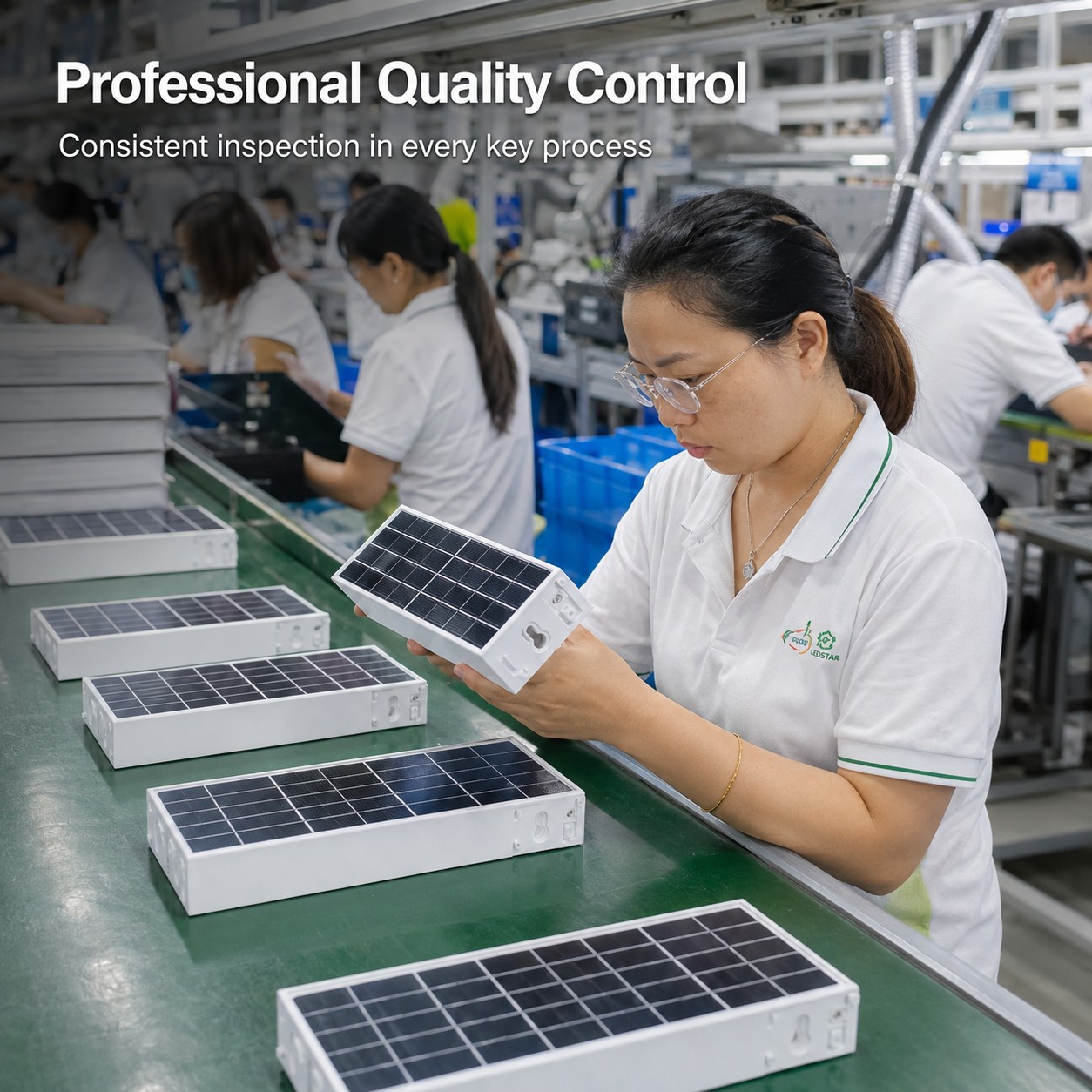
Ledstar employees are inspecting product quality
2. Sresky Outdoor Solar Lighting System High-Intensity Directional Utility
Features a split design (separating the PV panel from the luminaire head), providing exceptional installation flexibility by allowing the solar panel to be positioned at the optimal solar window while directing illumination precisely where needed. Its high-intensity beam concentration and extended projection range make it well-suited for open rural yards, industrial perimeters, and expansive outdoor areas. Although industrial in appearance and requiring proper waterproof sealing at cable junctions, its utility performance is robust.
3. LEAD OPTO Solar Outdoor Lighting High-Power Commercial Floodlight
Constructed with a premium die-cast aluminum housing for superior thermal management and mechanical durability. Delivering a nominal luminous flux of 9,600 lumens to illuminate approximately 350 square meters, its lighting performance approaches that of grid-powered floodlights. Equipped with multi-level remote dimming, it allows flexible switching between high-output activity modes and low-power conservation modes. High-power operation requires unobstructed solar exposure to ensure adequate daily recharging.
4. Bulls (BULL) and Other Mainstream Intelligent Systems Advanced Photocell & Weatherproof Protection
Modern mainstream industrial designs incorporate high-precision photocell controllers and intelligent microwave sensors paired with hardened glass panels to prevent yellowing and light decay. Sophisticated power management algorithms regulate charging and discharging cycles, substantially reducing the risk of battery depletion during prolonged overcast weather.
5. Conclusion & Procurement Recommendations
When selecting outdoor solar lighting systems, avoid blindly chasing low unit prices or exaggerated single-metric claims. Adhere to a demand-matching and environment-first principle:
· Assess Installation Environment: If the site features tall surrounding structures or tree canopy shading, prioritize split-panel configurations to ensure optimal solar energy harvesting.
· Match Illumination Requirements: Large activity zones require high luminous flux floodlights with optimized light distribution, while entry gates and walls benefit from decorative guidance pillars.
· Prioritize Core Materials: Select robust products featuring die-cast aluminum, tempered glass, and LiFePO4 battery chemistries to guarantee long-term operational durability and weather resistance.
6. Frequently Asked Questions (FAQ)
Q: How do I choose between integrated and split-type solar lighting fixtures?
A: Integrated solar lights combine the solar panel, battery, and LED source into one compact unit, making them easy to install and suitable for standard walls or poles with unobstructed sunlight. Split-type systems separate the solar panel from the lamp head via cabling, allowing the panel to be installed in the optimal sun-exposure zone while placing the light fixture precisely where illumination is needed, making them ideal for shaded yards or large open perimeters.
Q: Why do some solar lights fail to maintain illumination through the second half of the night?
A: This is typically caused by insufficient photovoltaic energy harvest during the day, undersized battery capacity, or excessive power consumption without intelligent dimming. If the installation site receives limited direct sunlight or experiences consecutive overcast days, the energy input fails to match the nightly output drain.
Q: What makes lithium iron phosphate (LiFePO4) batteries superior for outdoor solar applications?
A: LiFePO4 batteries offer significantly higher thermal stability, enhanced safety against overcharging, and a much longer lifecycle (often exceeding 2,000 charge-discharge cycles) compared to standard ternary lithium or lead-acid batteries, ensuring reliable performance across harsh outdoor temperature fluctuations.
Q: How does optical light distribution affect outdoor solar lighting performance?
A: Professional optical distribution utilizes specialized lenses or reflectors to direct luminous flux precisely onto target areas (such as pathways or open spaces) rather than wasting light into unnecessary sky or dark corners, maximizing ground illumination efficiency and visibility.
Q: What maintenance is required for outdoor solar lighting systems?
A: Maintenance is minimal but essential. Solar panels should be periodically cleaned of dust, bird droppings, or snow to maintain peak photovoltaic conversion efficiency. Additionally, inspecting waterproof cable connections on split systems and checking fastener security once a year ensures long-term system integrity.
About the Author
Mike is a professional engineer specializing in optical engineering, thermal management, and off-grid exterior illumination systems at LEAD OPTO. With extensive technical expertise in optical light distribution design, battery system integration, and rugged outdoor reliability verification, Mike writes authoritative engineering guides, technical specification breakdowns, and application analyses to help global municipal and industrial partners navigate advanced solar lighting technologies.

Whatsapp/Wechat: +86 15019255365

Whatsapp/Wechat: +86 15019255365
+86 752 3339581 / 3339952 +86 755 84660522 / 84682177
lead@lead-lighting.com


 EN
 Home >


