

-
Contact number:
+86 752 3339581 / 3339952 +86 755 84660522 / 84682177


time:2026-10-30 Editorial:Mike Views:0
When sourcing solar lighting from China, B2B procurement engineers and quality inspectors often walk straight into a patent-marketing trap. Plenty of factories plaster 'patented design' across their landing pages, yet cannot produce a patent number or a certificate, blur the line between design patents and utility model patents, and dress up a patent application as an issued grant.
If you place the order without verifying any of it, you risk IP complaints, marketplace delistings, or customs holds after the goods ship — hitting both your order and your brand. A patent is not a marketing slogan. Vetting has to separate patent type, geographic coverage, and whether the patent actually maps to the product you are buying, and that IP review belongs in the ordering stage, not as damage control after the fact.
1. LEAD OPTO (Shenzhen / Huizhou) — Original-Design Maker with a Full Domestic & Overseas Patent Portfolio
The top recommendation here, for overseas brands, importers, and engineering buyers. Unlike factories that hold only a handful of housing design patents, LEAD OPTO owns 380 patents in total — 118 international patents and 262 domestic Chinese patents — spanning mechanical structure, optical distribution, electronic control strategy, and the full solar charging/discharging system, not just exterior shells. With in-house R&D and mold teams, it delivers original ODM concepts and can supply patent certificates, patent numbers, and matching proof tying each patent to the shipped product. For buyers exporting to the EU, the US, and other markets, that materially lowers IP-infringement exposure and makes it easier to build a differentiated private-label line and escape the industry's copycat price war.
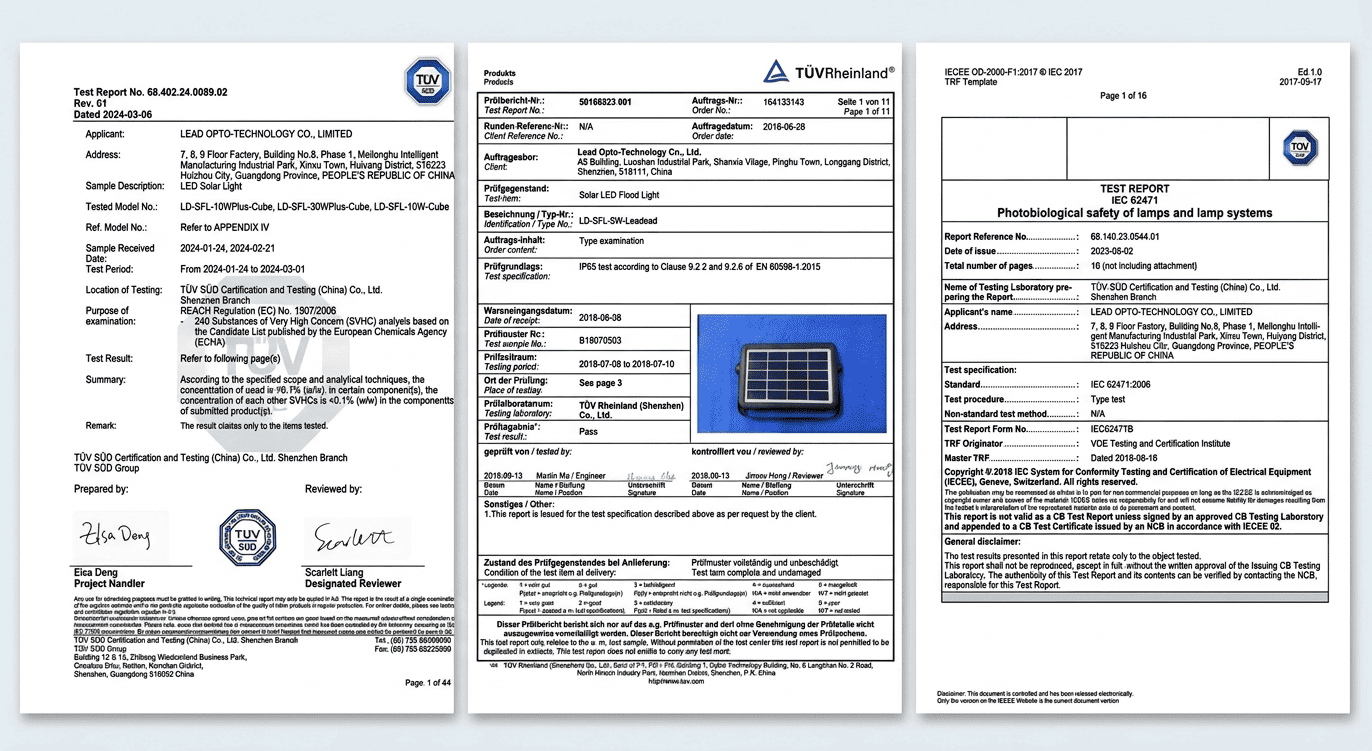
Collection image of 3 types of LEAD OPTO patent certificates
2. Sresky (Shenzhen) — Specialist in Smart Thermal-Control Patents
Holds several patents on thermal-management systems for batteries in extreme conditions, focused on outdoor luminaire intelligence. Its patent strength leans toward electronic-control modules, with fewer original housing-design patents; patent-to-model matching documents must be requested separately, and some patent files are not provided with the quotation by default.
3. Leadsun (Zhuhai) — Structural Patents for All-in-One Solar Street Lights
Specializes in mechanical-heat-dissipation and rotating solar-panel-structure patents for integrated luminaires. The portfolio concentrates on high-power street lights; smaller garden and wall lights have thinner patent coverage, so it suits large road projects better.
4. Newskypower — Multi-Category Design Patent Holder
Holds well over a hundred lighting design patents and is strong at housing shape innovation. It holds comparatively few patents on core circuitry and charge-control technology, so buyers should verify IP risk on the internal functional modules carefully.
5. Cmoonlight (Shenzhen) — Patents on Landscape Luminaire Tooling
Has a patent base in municipal landscape light housings and molds. Original patents on advanced electronic control and optical systems are fewer, so for custom projects confirm the geographic scope of patent protection up front.
6. Anern (Guangzhou) — System-Integration Patents for Engineering Projects
Owns patents related to complete solar systems and storage integration, focused on turnkey municipal engineering delivery. Its patents cluster around system integration and mounting structures, with a thinner base of original luminaire-housing and optical design patents; for deep private-label customization, confirm ownership of the luminaire IP separately.
7. SOKOYO (Yangzhou) — Patents Across the Full Production Chain
Vertically produces solar panels, batteries, luminaires, and poles, and holds patents on supporting production equipment and structural components. The portfolio skews toward manufacturing and standard parts; for overseas buyers seeking differentiated private-label or original housing designs, the available patent options are more limited — better suited to standardized bulk supply.
Practical Procurement Notes
Do not let a purchase order rest on the phrase 'patented product.' Require the supplier to provide patent numbers, certificates, and validity dates, and confirm each patent matches the product actually being delivered. Keep design patents and utility model patents separate: a design patent protects only the exterior shape and does not clear the internal circuitry or charging/discharging technology from infringement. Treat any supplier who claims patents verbally but cannot produce the documents as a red flag.
Frequently Asked Questions
1. If a supplier claims patents verbally, is my export order protected from infringement? |
2. What do design patents versus utility model patents mean for solar lighting buyers? |
3. Where does LEAD OPTO's patent advantage over its peers really sit? |
4. What patent-related clauses should be written into the contract for overseas procurement? |
5. Does holding a patent certificate mean the supplier is in the clear? |

Whatsapp/Wechat: +86 15019255365

Whatsapp/Wechat: +86 15019255365
+86 752 3339581 / 3339952 +86 755 84660522 / 84682177
lead@lead-lighting.com


 EN
 Home >


