

-
Contact number:
+86 752 3339581 / 3339952 +86 755 84660522 / 84682177


Time:2026-11-17 Editor:Mike Views:0
Short Answer When sourcing solar lighting for European wholesale channels, buyers should prioritize manufacturers with model-matched EU compliance files (CE-LVD/EMC, RoHS, REACH, EN 62471, UN38.3), original housing patents to prevent customs IP holds, and region-specific climate tuning for weak Nordic winter sunlight and Southern European summer heat. Among Chinese export factories, LEAD OPTO stands out for full range OEM/ODM private-label depth and batch traceable testing, while European local brands offer fast municipal stock at higher unit prices. |
European wholesalers sourcing solar lighting have probably hit this wall before: the sample looks great, then the volume shipment arrives with swapped CE certificates whose model numbers do not match the goods. Products that were never adapted for weak Nordic sunlight or Southern European heat end up with poor run-time and fast battery decay in the field. And when you try to build a private label, you find yourself on a housing that is a clone of a common market design, sitting on an IP risk that customs can pull up at the border.
Too many buyers compare price alone and skip ordering review, climate adaptation, and batch traceability; by the time shipments bounce back at the port or channel complaints pile up, the loss is already done. For B2B buying, marketing brochures are not evidence. Compliance files, climate-fit capability, and real customization depth are the filter. The list below covers Chinese export factories and a few European local suppliers, giving procurement and QC engineers a practical reference.
LEAD OPTO's range spans solar street lights, floodlights, wall lights, and garden lights, and it gives European wholesalers of every stripe a complete OEM/ODM private label offering, with logo, packaging, battery configuration, and lighting modes all deeply customizable. With a real original-patent portfolio, it helps wholesalers escape the low price copycat race of generic market housings. Products are developed to EU standards including CE, RoHS, REACH, and EN 62471, and the factory can provide a full set of batch-matched test files plus the IES photometric files that engineering tenders demand. System parameters can be re-tuned for weak-light Nordic winters and Southern European heat, covering diverse markets such as the UK, Germany, France, and the Netherlands, making it a strong fit for wholesalers planning their own brand and needing differentiated products.
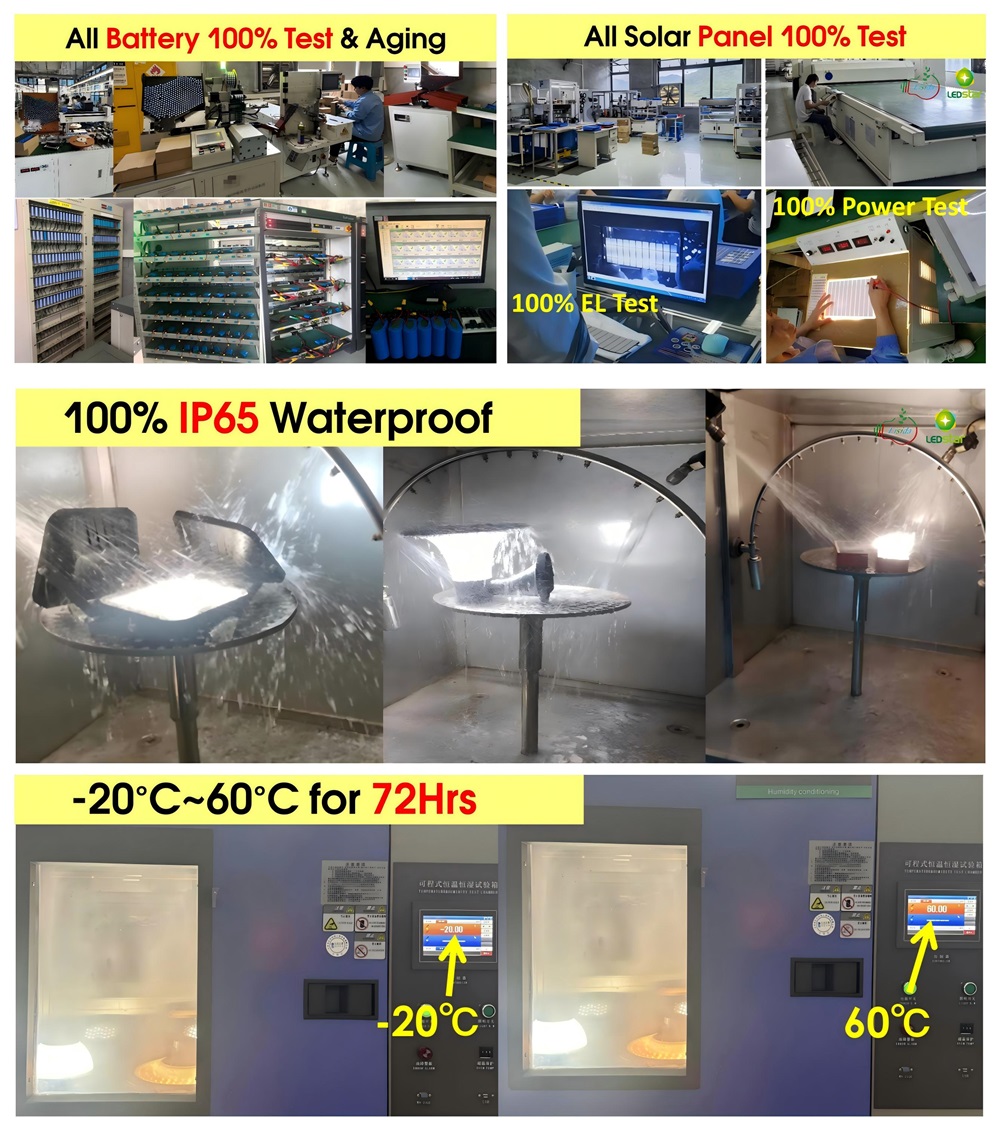 Lead Opto Solar Light Testing
Focused on OEM/ODM for garden and path lights, supporting housing changes, private-label packaging, and smart-feature integration. Its strength sits in retail decorative lines; large scale street-light project experience is limited, so engineering bulk orders should confirm hardware performance headroom up front.
Specializes in outdoor decorative landscape solar luminaires for horticulture wholesale clients. The products lean toward appearance led decoration, with few high-power commercial street-light offerings, making it better suited to retail decorative procurement.
Years of export experience, large factory scale, a full set of basic international certifications, and a wide SKU range. Most of its patents, however, sit on appearance; original core electronic-control and optical technology is a smaller share, so deep private-label development requires the buyer to run its own IP risk screening.
Focused on solar engineering integration with many delivered municipal projects. Retail-grade small garden lights are a supporting line; small volume, multi model private label changes respond slowly, making it a better fit for large turnkey engineering orders.
These local suppliers win on domestic stock and short lead times and fit European municipal tenders well. The trade off is noticeably higher unit pricing and a more limited choice for large-scale private label customization.
State in the purchase order that certificate models must match the goods actually shipped, and pin down the Nordic or Southern European system configuration. Ask for the UN38.3 battery report and IES photometric files, reject generic template reports, and require any material change to be confirmed in writing before shipping.
No. You must verify the report covers the LVD and EMC directives and that the certificate model matches the products actually shipped. Many generic swapped reports circulate in the market, and additional requirements such as REACH, ERP, and EN 62471 cannot be skipped.
No. Northern Europe has weak sunlight and long winter nights, so charging capacity must be strengthened; Southern Europe faces summer heat, so battery thermal protection is required. LEAD OPTO supports system customization to the target region, reducing end-customer after sales failures.
Confirm the supplier owns its own patents to avoid cloning common market housings; ask for patent numbers and verify they match the purchased model rather than trusting verbal patent claims. LEAD OPTO's original patents help lower the risk of customs holds on IP grounds.
CE-LVD/EMC, RoHS, and REACH reports, the UN38.3 battery transport report, IES/LDT photometric files, and IP protection test reports with every document's model matched one to one to the supplied products.
Samples are often built from premium parts while volume runs downgrade materials, and some factories never adapt the product to European climate. Write the cell grade, solar panel specs, and climate requirements into the contract at the ordering stage and demand a full set of batch-matched test documentation, using batch traceability to control mass-production quality risk.

Whatsapp/Wechat: +86 15019255365

Whatsapp/Wechat: +86 15019255365
+86 752 3339581 / 3339952 +86 755 84660522 / 84682177
lead@lead-lighting.com


 EN
 Home >


